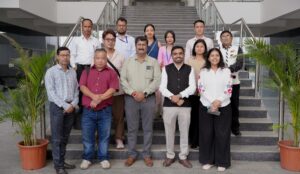
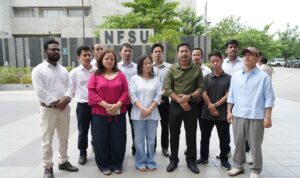
Arunachal Media delegates visit Forensic University, Gandhinagar
Read Time:4 Minute, 24 Second
Gandhinagar, 10 Sep : The National Forensic Sciences University (NFSU), Gandhinagar, an Institution of National Importance under the Ministry of Home Affairs and the world’s first university dedicated to forensic sciences, has emerged as a global centre for forensic investigation and capacity building, assisting around 102 countries in developing their forensic capabilities.
The university is also handling critical forensic samples from across India, including several samples from Arunachal Pradesh and other northeastern states.
The information came to light during an interaction between NFSU officials and a media delegation from Arunachal Pradesh, which visited the university campus in Gandhinagar on Wednesday as part of its exposure visit to Gujarat.
Addressing the delegation, a senior NFSU official said the university is equipped with cutting-edge technologies and expertise to assist in almost every type of criminal investigation.
Highlighting the growing role of forensic science in India’s criminal justice system, the official said scientific evidence is more reliable than dependence solely on oral or eyewitness testimony.
“An eyewitness can turn hostile, cases can continue for years and sometimes the witness or victim may no longer be available,” the official said, stressing that dependence on eyewitnesses alone cannot be considered foolproof.
He said forensic science, being based on scientific analysis, provides objective evidence that is far less vulnerable to manipulation.
According to the official, even seemingly insignificant items recovered from a crime scene—including cigarette butts, handkerchiefs, footwear, blood, urine, saliva, sweat and other bodily fluids—can provide crucial evidence during an investigation.
He said the collection, handling and storage of such evidence are now being systematically documented through videography and photography to maintain the chain of custody and minimise the possibility of tampering.
The official also recalled the shortcomings of forensic evidence management in the past, particularly in the storage of viscera samples. Earlier, viscera collected during post-mortem examinations was sometimes stored in a single bottle and kept under unsuitable conditions, including high temperatures.
Such practices could result in the deterioration of samples, making DNA extraction and other scientific examinations extremely difficult. The situation was further compounded by long pendency in forensic laboratories, with some cases remaining unresolved for four to five years.
However, the official said the system has undergone a major transformation following the introduction of the new criminal laws.
He said evidence-storage procedures have been standardised, with the law specifying appropriate containers and temperature conditions for preserving different types of evidence. Modern facilities have also been created in forensic science laboratories to ensure that samples are preserved scientifically and securely.
The official highlighted three major changes under the new criminal justice framework. These include mandatory forensic visits to crime scenes in offences punishable with seven years or more of imprisonment, compulsory videography and photography of the collection of forensic samples, and legal recognition of digital and electronic evidence.
He said electronic evidence such as WhatsApp chats, SMS messages, call records and emails can now play an important role in criminal investigations and judicial proceedings.
Deleted Data Can Still Be Retrieved
On the growing challenge of cybercrime and digital investigations, the NFSU official said the university is receiving around 10 cases every day involving crimes ranging from theft and murder to accidents.
In many such cases, investigators bring multiple digital devices—including mobile phones, laptops, pen drives and CDs—for forensic examination.
He cautioned that deleting messages, call records or other files from a mobile phone does not necessarily mean that the data has been permanently erased.
According to the official, forensic technology has advanced significantly and investigators can recover substantial amounts of deleted digital data from devices, depending on the condition of the device and the available data.
He said people often believe that deleting a photograph, message or WhatsApp conversation makes it impossible to recover. However, digital traces may continue to exist within the device or associated storage systems and can potentially be retrieved through forensic examination.
The official said forensic experts can, in appropriate cases, examine historical data stored on a device, making digital forensics an increasingly important component of modern criminal investigations.
NFSU Created to Address Forensic Manpower Shortage
The official said one of the primary reasons behind the establishment of NFSU was to address the acute shortage of trained forensic professionals in the country.
He said thousands of forensic-related posts remain vacant across India, even as governments are expanding forensic laboratories, establishing new divisions and procuring advanced equipment.
A full-fledged forensic science laboratory can have 15 to 17 specialised divisions, covering areas such as DNA, fingerprints, documents, serology, cyber security, digital forensics, narcotics, toxicology, electronics, ballistics and psychology.
However, the official pointed out that the availability of sophisticated equipment alone is not sufficient without trained professionals capable of operating and interpreting the technology.
He said the country previously lacked adequate specialised training facilities and a dedicated institution capable of developing the skilled human resources required for modern forensic investigations.
NFSU was therefore established to create a pool of highly trained forensic professionals and strengthen India’s capacity to investigate crime through scientific and technology-driven methods.
The interaction provided the Arunachal Pradesh media delegation with an insight into the rapidly evolving field of forensic science and the increasing importance of scientific, digital and technology-based evidence in India’s criminal justice system.


Happy
0 %

Sad
0 %

Excited
0 %

Sleepy
0 %

Angry
0 %

Surprise
0 %
 0
0
 0
0